AI Has a Chromebook Problem
Why the world's most powerful technology still makes you wait — and what Apple's new CEO signals about what comes next
AI TRENDS
Kenneth Lam
4/22/20263 min read
AI Has a Chromebook Problem
Why the world's most powerful technology still makes you wait — and what Apple's new CEO signals about what comes next
Six months ago, I purchased a Chromebook. I have always known it was an inferior device compared to a Windows-based PC. But a few years back, at my previous company, management announced that all PC replacements would be Chromebooks. IT assured us it was just as good, and we would enjoy working anywhere with the cloud.
I did not fully understand how inferior the experience was until a few weeks ago, when I had to use it intensively during an entrepreneurship bootcamp at SUSS. Before that, I had used it only sporadically, since my favourite device is my mini-PC at home with two 27-inch screens.
The Chromebook was so slow. I found myself waiting for the cloud to respond, frustration mounting by the hour. It took a few days to realise I had been living a version of this experience already, just in a different form. I am talking about AI chatbots like ChatGPT, Claude, and Gemini. We are all, without quite admitting it, living the Chromebook life.
It Is All in the Cloud
The race today is for everyone to scale up AI skills. Almost everyone uses AI at a personal level. I started with simple questions and was genuinely wowed. Then I moved to composing birthday poems for friends — my favourite was converting them into Phua Chu Kang style. Try it sometime.
But as I pushed into more complex tasks — vibe coding, multi-step research, long-form drafting — the slowness became unavoidable. I could walk away for half an hour and still return to a spinning cursor. Like the Chromebook: slow, waiting for the cloud, yet we tolerate it. No wifi, no data, no work done.
That personal frustration scales up quickly. When AI moves inside companies — powering agents, automating scheduled tasks, running across entire departments — the demand on the cloud multiplies. Most organisations are still at the beginning of the AI learning journey, still experimenting with chatbots rather than deploying AI productively at scale. And yet the cloud must bear the weight of all that experimentation, all at once, all the time.
From Cloud to On-Site
There is a counter-movement gathering beneath the surface, and Apple may be its most telling signal.
MacBooks with M5 chips have already demonstrated that significant AI processing — running large language models, generating images, accelerating complex workflows — can happen directly on the device, without reaching for the cloud at all. Microsoft's Copilot+ certification now requires a dedicated Neural Processing Unit built into every qualifying PC. Qualcomm's AI-ready chips are powering a new generation of Windows machines built on the same premise: bring the processing closer to the user, and cut the cloud dependency out of the equation.
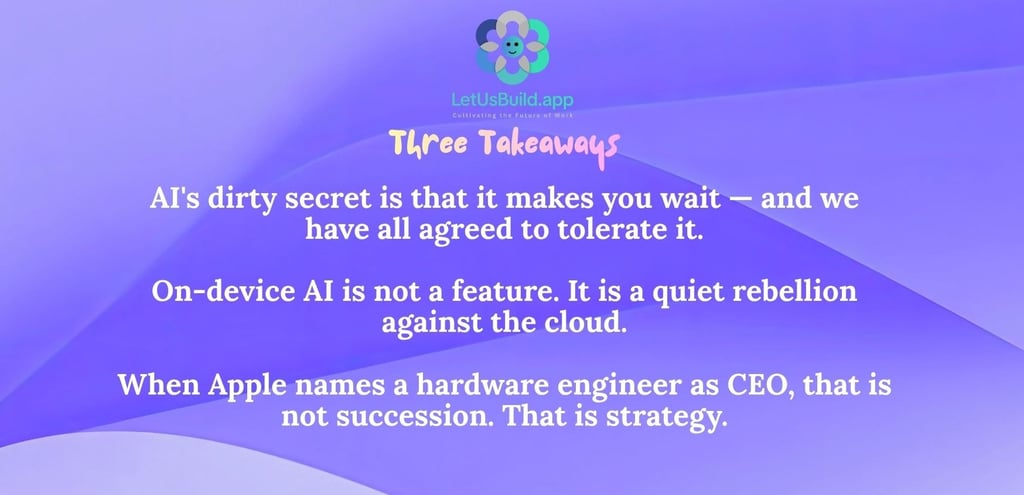
But it was Apple's announcement this week that deserves closer attention. John Ternus — the company's head of hardware engineering and the architect of Apple's silicon chip programme — has just been named as Tim Cook's successor. Ternus is an engineer, not an operator. His appointment is a strategic signal, not just a leadership transition. Under Cook, Apple's AI story was largely a software one — Siri improvements, Apple Intelligence features, cloud-based services that frankly underwhelmed. Under Ternus, the more logical bet is that Apple's AI ambitions shift decisively toward the device itself. More powerful chips. More on-device inference. Less dependence on the cloud that everyone is still waiting for.
If that is the direction Apple moves, the rest of the industry will follow. It always does.
The Question Worth Sitting With
Two trends are now running in opposite directions at the same time. The on-device movement is quietly making the cloud less necessary. Meanwhile, the cloud continues to expand, on the assumption that demand will only grow. Both cannot be fully right.
We tolerate the slowness because we believe the payoff is coming. Perhaps it is. But the more interesting question is whether the cloud-first model of AI delivery has already peaked — and whether the spinning cursor we all stare at today is less a temporary inconvenience and more a permanent feature of a model that was never quite built for us.
That is worth thinking about the next time you wait for the cloud.
Cultivating the Future of Work
Empowering businesses through human-centered AI.
© 2025. All rights reserved.
LetUsBuild | UEN: 53522535X